May 1

VMware Partners get access to a very nice tool called Capacity Planner–this is what VMware Partners use to come in and do an assessment of your environment and determine what can be virtualized, and how many hosts are required to make it happen.  VMware Partners use the tool free of charge from VMware–the partners and are encouraged to do these assessments at no cost for customers (after all, the results from a capacity planner assessment leads into a vSphere PoC for new customers typically).  However that left customers crying that they should have something they can run themselves–why should they have to bring in a partner to do this?

VMware answered customers by creating  vCenter Guided Consolidation–it doesn’t pack anything near the features VMware Capacity Planner does–but it offers the very basic functionality of if a particular server (and associated workload) is a good candidate for virtualization.
Installing Guided Consolidation

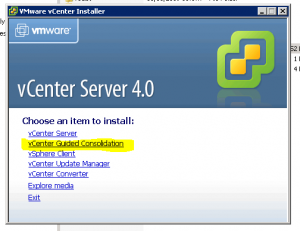
So you need vCenter for this if it wasn’t apparent.  It’s simply a plugin to vCenter–now the install process actually stumped me for a bit, I browsed the vCenter media for the installer and came up empty handed…then a college pointed me to the Autorun menu on the vCenter media and I face palm’d…I never let Autorun actually run–haha.

Poking around wanting to find the installer after seeing it in the Autorun menu I found that damn installer.  It’s at ./vpx/VMware-gcs.exe on the media.  GCS-Perhaps Guided Consolidation Server?

Using Guided Consolidation

This is broken up into 3 main steps:

  1. Find – Discover your physical servers
    • Find offeres these ways to discover
      • Manually enter Hostname/IP Addresses
      • Domain Discovery — via Active Directory Domains
      • Scan an IP Range
      • Suck in a text file containing a list of Hostnames/IP addresses to scan
  2. Analyze – Perform analysis on the servers to determine if they are good candidates for virtualization
    • Once a machine is actually being analyzed this is where Guided Consolidation can use some improvement–there is no log or status as to what is happening–you typically have to wait at least an hour before any status changes appear.
    • Also note that confidence won’t change to High until it analysis has been in-progress for at least 12 hours (might be 24 actually) so don’t be alarmed
  3. Consolidate – Complete the actual consolidation by P2V
    • Another area that has ALOT of room for improvement in Guided Consolidation
    • After you are happy with the analysis of a server select it then click the Plan Consolidation button.
    • A wizard appears that one would think would offer similar functionallity when doing P2Vs using regular VMware Converter–but no, it’s not the same at all.
    • Select your destination(s) vcenter/cluster/hosts
      • Guided Consolidation will analyze the hosts and recommend the best destination for the VM with the Amazon-esc 5-Star rating icons.
    • Review the recommendation–you can change the destination host as well as destination VM name in this window
    • Once you click next, you have one more chance to review….and then a finish button?! what?–I want to change vCPUs, Memory, Target Disk Layout!

And so now you can see the limitations of Guided Consolidation–it’s great at the core function of determining if a server is a good canidate to virtualize or not–however the built in P2V process leaves alot to be desired for the seasoned VMware Admin.  I recommend you use the analysis portion and continue to use vCenter Converter to perform the actual P2V so you have more control over the P2V process–changing Target Disk Layouts, vCPU count, Memory amounts, etc.

For more information on VMware vCenter Guided Consolidation check out the vSphere 4 Admin Guide @ VMware.com
Apr 26
Introducing PXE Manager for vCenter
icon1 Michael Requeny | icon2 VMware | icon4 04 26th, 2011| icon3No Comments »

PXE Manager for vCenter enables ESXi host state (firmware) management and provisioning, Specifically, it allows:

  • Automated provisioning of new ESXi hosts stateless and stateful (no ESX)
  • ESXi host state (firmware) backup, restore, and archiving with retention
  • ESXi builds repository management (stateless and statefull)
  • ESXi Patch management
  • Multi vCenter support
  • Multi network support with agents (Linux CentOS virtual appliance will be available later)
  • Wake on Lan
  • Hosts memtest
  • vCenter plugin
  • Deploy directly to VMware Cloud Director
  • Deploy to Cisco UCS blades

What does that mean?  It automates the provisioning of ESXi hosts in either a stateless or stateful mode.  (notice no ESX support here!) via network boot using Pre-boot eXecution Environment (PXE)

How does that work?

Remember ESXi has a very small footprint–it’s quite small that PXE booting ESXi is very easy.

Stateless and Stateful?

Stateful means the host keeps the “ESXi state” upon reboot–meaning the same version.  Think back to Microsoft RIS (remote installation services) days for VMware ESXi.

Stateless means the host doesn’t keep the ESXi state upon reboot.  Why the heck would you want to do that you might ask?  I say why the heck wouldn’t you want to do that?  Patching and upgrades becomes a breeze, throw a host into maintence mode–all the VMs evacuate to other hosts in the cluster then reboot the host.  When it comes up it’s running the latest and greatest version of ESXi.  No extra leg work patching the host, it gets it automatically upon boot!  Think of the possibilities with DPM in the mix, a good amount of your environment can be automatically upgraded nightly when hosts get powered back on by DPM.

Provisioning

Provisioning becomes much easier–no need to install ESXi, and along with that the extra hardware required (SD Cards + Reader, Mirrored OS Drives, etc.)  Just rack new hardware and configure the BIOS for PXE boot and go!

Want to learn more?  Max Daneri threw together a great overview powerpoint

Ready to download? Grab it from VMware Labs and while your there check out other cool new things VMware is working on.

Apr 22

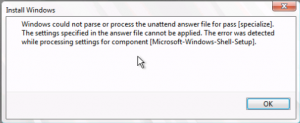
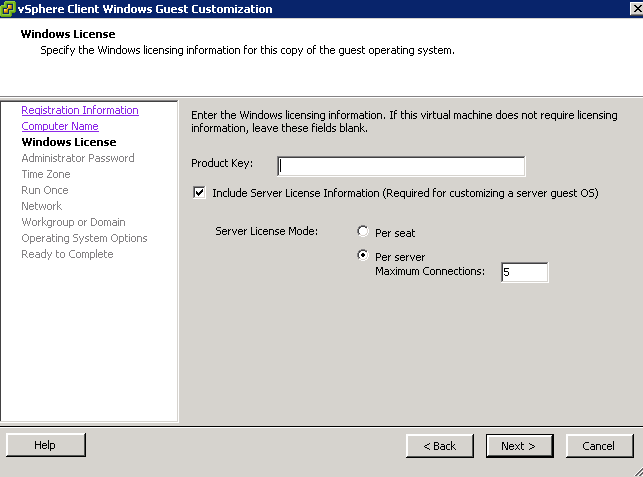
When using guest customization specifications in vCenter you may come across the following error when deploying a VM using a specification:

Windows could not parse or process the unattend answer file for pass specialize.  The settings specified in the answer file cannot be applied.  The error was detected while processing settings for component [Microsoft-Windows-Shell-Setup].

The Solution

Edit the specification and double check your product key, an invalid key is a common reason for this error.  In my experience Windows 2008 and Windows 2008 R2 keys cannot be interchanged–yet I see this attempted to be done in guest specifications.

Apr 3

Your just going about your day, trying to P2V a machine using the Cold Clone when you get the error: Unable to determine Guest OS

You check the client log and don’t find anything helpful:

Then you check the agent log and it sheds light on the problem:

Looks like WinPE didn’t find a suitable driver for our storage adapter.  Not a problem heres the steps to correct this:
Mar 25

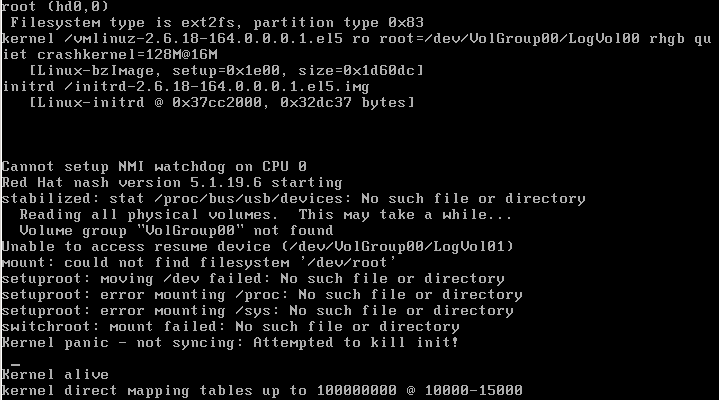
So you P2V’d a Linux box (CentOS, RedHat, Oracle, etc.) that is using LVM and now when it boots you get:

Reading all physical volumes. This may take awhile…
Volume group “VolGroup00” not found
Unable to access resume device (/dev/VolGroup00/LogVol01)
mount: could not find filesystem ‘/dev/root’
setuproot: moving /dev failed: No such file or directory
setuproot: error mounting /proc: No such file or directory
setuproot: error mounting /sys: No such file or directory
switchroot: mount failed: No such file or directory
Kernel panic – not syncing: Attempted to kill init!

Well that sucks–basically initrd didn’t have the right drivers to access the file system.

Reboot the VM with the Linux distro ISO attached

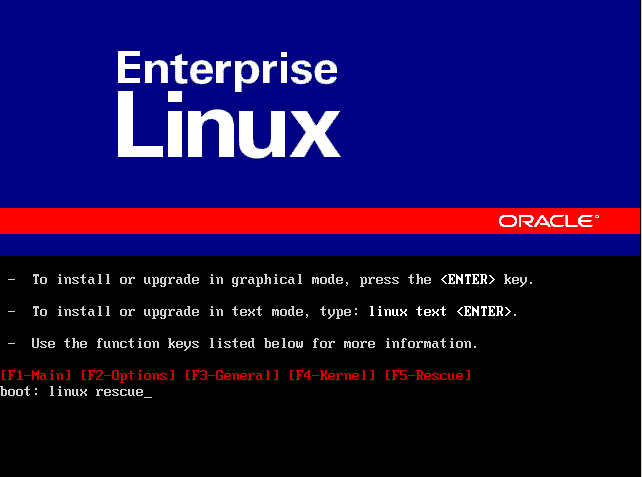
Then it boots from the CD follow the instructions to enter Linux Rescue (usually you type “linux rescue” at the boot prompt)

Now we can rebuild initrd with the missing drivers.

Enter:


Type:

Now hit tab and it will auto complete then add the text that was autocompleted when you hit tab except for the .img

So your command should look like:

Hit enter and it will do it’s thing with a lot of output coming out, when it’s done type exit annd exit again and the VM will reboot automatically.  Should boot up just fine this time.

Mar 19

My zoom lens barrel was stuck and wouldn’t zoom out–it would stick at 100mm and wouldn’t move further in.

Start by removing the 4 screws at the back of the lens on the EF mount.

Then remove the 3 tiny screws inside of the EF mount, 2 hold the electric contacts inplace.

Now lift the EF mount plate up, you may have to rock it side to side gently, you won’t be able to lift it very far due to a ribbon cable so be careful.

Read the rest of this entry »

Mar 19

Dust behind your front lens element?  Not to worry–disassembly is easy:

Remove the 3 black phillips screws around the front edge:

You can now lift that front ring off the rest of the lens.

Don’t bother trying to unscrew these next 3 phillips head “screws” they are pins that you’ll need to remove with some small needle nose pliers.  Pull them straight out, they come out very easy.

Now carefully tip the lens over being careful not to let the front lens element fall out, if it doesn’t fall out easily gentle tap and shake the lens a bit and it should fall right out.

This is what the inside of the lens looks like

Now you can clean the dust off the back of the front lens element, reassemble by reversing the disassembly process.


Mar 15

If you are building server images/templates and want to document how you’ve built them why not list the updates that are installed?  Cool, but we can’t copy-pasta the updates in bulk…These tools will handle this for you:

Windows Server 2003

If you are running Windows Server 2003 take a look at WUL (Windows Update List) a freeware app from Nirsoft.  You can download it as a .zip which has the standalone version that doesn’t require an install.  Check it out @ http://www.nirsoft.net/utils/wul.html.  Unfortunately this doesn’t work for Windows Server 2008…

Windows Server 2008

So if your running Windows Server 2008 and want to export a list of updates, there is a built in tool to do this.  Using WMIs Command-line interface (WMIC) you can export this list.

Launch a command prompt and type:

Also note that instead of a csv you can use these other format options:

HFORM/HTABLE are HTML
LIST is Tab Delimited
RAWXML is XML

Mar 7
P2V: Domain Controllers in-depth
icon1 Michael Requeny | icon2 VMware | icon4 03 7th, 2011| icon33 Comments »

The official VMware KB 1006996 on virtualizing existing domain controllers recommends 4 options (simplified below):

  1. Demote the DC via dcpromo, do the conversion, then promote the DC back again using dcpromo–With all that trouble why not just build a new one?
  2. Cold Clone–Cool, except if I’m working remote I need a working out of band management solution to boot the DC with the ISO…or setup a PXE server to provide a bootable cold clone image to do this, regardless too much extra leg work.
  3. Use Directory Services Restore Mode (DSRM) and do a hot conversion, cool, but now I need to reboot these guys and hope someone remembers the DSRM password, or reset it before hand…
  4. Get rid of the old DC via dcpromo and build a new VM and promote it–no conversion at all, wait what?

Having to P2V over a hundred DCs we didn’t particually like any of these options, the KB focuses on the possibility of a corrupt NTDS.DIT if you don’t follow any of those recommendations.  For our first few we did the DSRM route:

Read the rest of this entry »

Feb 27

This is an updated version with more Intel removal goodness…see my previous post for more information on Automated P2V Cleanup: Remove/Uninstall Dell OpenManage & Broadcom/Intel Drivers

This Removes:

  • Dell OpenManage Server Administrator
  • Broadcom Drivers and Management Applications
  • Broadcom NetXtreme II Driver Installer
  • Intel(R) PROSet for Wired Connections
  • Intel(R) PRO Network Connections

Read the rest of this entry »

« Previous Entries Next Entries »