Nov 21

If your trying to configure vCenter Orchestrator to use a local Microsoft SQL Express database and you get the error: Unknown host: Error when connecting to host localhost/127.0.0.1, port 1433: Connection refused: connect

You need to change a few options on your SQLExpress server to accept this connection.

  1. Launch SQL Server Configuration Manager
  2. Navigate to SQL Server Network Configuration->Protocols for SQLEXPRESS on the left column
  3. Double-Click on TCP/IP
  4. Ensure Enabled is set for Yes
  5. Ensure Listen All is set for Yes
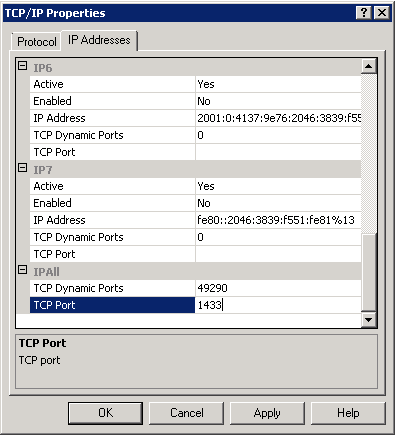
  6. Click the IP Addresses Tab
  7. Scroll to the bottom and find IPAll
  8. Set TCP Port to 1433 for IPAll
  9. Hit Ok, and Ok to the dialog box that pops up
  10. Navigate to SQL Server Services on the left column
  11. Right-Click SQL Server (SQLEXPRESS) and select Restart
  12. Try again and your Orchestrator server should be able to connect to the database now
Nov 20

So you decided to take the plunge and buy the Dell Management Center vCenter Plugin but it’s not registering with your vCenter?  In my case, the virtual appliance spit out all kinds of errors–SSL errors, unknown errors, timeouts…
Well, the fix for me was simple–apparently Dell doesn’t make the latest version avaliable online, you may have downloaded an older version from Dell’s site and Dell expects you to simply update the appliance online after you deploy it.
To do this:

  1. Login to the appliance admin portal with your previously set admin password (https://[ApplianceIP]/DellAdminPortal/index.html)
  2. Now navigate to Appliance Management on the left column
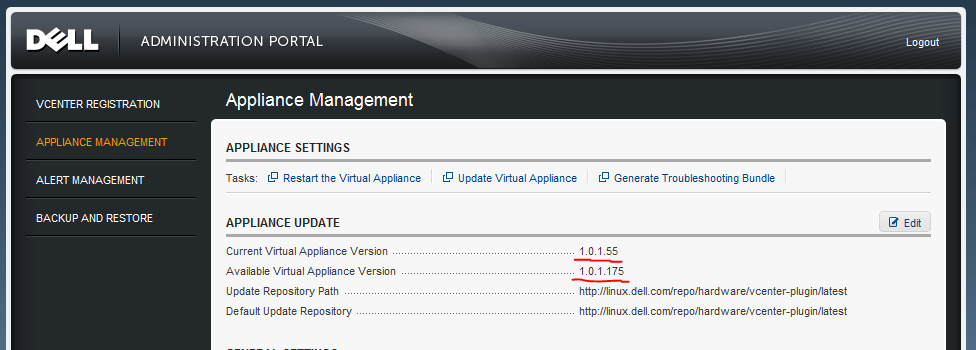
  3. On this page you’ll see 2 lines near the top: Current Virtual Appliance Version and Available Virtual Appliance Version, if the Available version is higher then the current, click Update Virtual Appliance to install the update

  4. It takes about 5-10min to complete, the virtual appliance will reboot at some point, once you get a login screen at the console it should be ready to proceed
  5. Go back to the appliance URL in your web browser and login (https://[ApplianceIP]/DellAdminPortal/index.html)
  6. From here you’ll see a link to register with vCenter near the top–click that
    1. Enter the IP or Hostname for your vCenter server
    2. Provide User Credentials with admin access in vCenter & hit register
  7. Once registration is complete you will get a message to relaunch a vSphere Client and connect  to the vCenter to access the plugin, so do that and go about configuring the rest of the plugin.
Nov 17

This is another updated version with more Intel removal goodness…see my previous post for more information on Automated P2V Cleanup: Remove/Uninstall Dell OpenManage & Broadcom/Intel Drivers Updated so it removes all the new Dell/Intel/Broadcom stuff released since the last update.

This Removes:

  • Dell OpenManage Server Administrator
  • Broadcom Drivers and Management Applications
  • Broadcom NetXtreme II Driver Installer
  • Intel(R) PROSet for Wired Connections
  • Intel(R) PRO Network Connections

Read the rest of this entry »

Oct 26
P2V Tips
icon1 Michael Requeny | icon2 VMware | icon4 10 26th, 2011| icon3No Comments »

Pre-P2V

  • Cleanup Irrelevant Data
    • Don’t bring over that downloads folder on every server full of drivers, hotfixes, patches, service packs, etc.  Remember storage is now shared among many VMs now, try not to duplicate things like that.
  • Stop transactional services during P2V
    • MSSQL, mySQL, etc.
  • Disable Windows Updates
    • You don’t want your source to reboot due to automatic updates mid-P2V
  • Do not resize volumes during P2V
    • Resizing volumes will increase P2V time significantly because instead of doing a block-level copy the convert would have to use file-level copy
  • Set Target disks to Thin
    • Take advantage of thin provisioning–make sure you have vCenter Alarms setup to alert you when datastores near capacity

Post-P2V

  • Move the Page File to a seperate volume (if it isn’t already)
    • If you are moving away from traditional backup methods to new vStorage methods you can’t exclude the page file from backups typically–however if it’s on a dedicated volume (separate vmdk) you can typically exclude it then
  • Don’t Team NICs
    • You should build redundancy at the vSwitch level and use a single NIC for the VM (having a separate NIC connected to another vSwitch for backups, or Internal/External Interfaces is still ok)
  • Cleanup
    • Get rid of all the extra software/agents physical servers require–Dell OpenManage, HP Insight, Broadcom/Intel Teaming Utilities – If your using Dell Servers use my Cleanup Script to automate the process
Oct 9

Here is my session on a quick overview of vCenter Orchestrator.

Thanks to Tony the VMUG Leader for posting the recordings from the Q3 SFL VMUG.

Links I spoke about:

Oct 7

Simple little code snippet that you might find handy to use in vCenter Orchestrator.  I am working on a workflow that needs to clone a VM and the name should increment by 1 for example, we want to clone appweb1 (but we already have appweb2, 3, 4) so we want the new VM to be appweb5.

Inside a new Scriptable task create an output parameter called newvmname and make it’s source itself.  Then use this bit ‘o code:

Oct 5

We needed a fast way to provision 180+ ESXi servers to boot from SD Cards, ESXi 4.1 introduced Scripted Installation to ESXi (the feature has been in ESX classic for awhile now)

However it is limited:

  • Installation on USB Devices (SD cards, flash drives, etc.) isn’t currently supported.

Uhoh, our plan is to use SD Cards in Dell PowerEdge T610s and Dell PowerEdge 29xx (I’ll explain how on the 29xx in a later post) for our installs.  This isn’t good…

We figured we could build a golden image and clone our SD cards from that, but cloning the SD cards proved difficult.  I tried a lot of different apps and nothing seemed to work–we had trouble with DD even.  Then I stumbled across this blog post from Luke: Fast deployment of vSphere ESXi 4.0 running on a 1GB SD-Card

Luke recommended WinImage to do this cloning, I still couldn’t get WinImage to work at first but a quick email to Luke cleared up my troubles (thanks again Luke)

It was good to see my process to create the gold image was similar to how Luke did his just a few minor variations:

Creating the Gold Image

  • Use a spare box for these steps–
  • Install the Dell customized ESXi 4.1 onto the SD Card
    • The Dell customized ESXi isn’t actually required–from what I’ve read it simply updates support links and other textual things to refer to Dells support pages for various things…but whatever.
  • Add the host in vMA so I can install OpenManage 6.3.0
    • OpenManage for ESXi is provided as a VIB and I choose to install via vMA
  • Set root password
  • Configure CIMOEMProvidersEnabled
  • Configure NTP
  • Add your license key–even if it’s ESXi free VMware will provide a license key — otherwise you’ll start the evaluation clock ticking…
  • Create custom roles
    • By default there are only three roles: No access, Read-only, and Administrator
    • I create an additional role, Virtual machine user with basic access to work on VMs (Power on/off, Remote Control, Mount Discs, etc.)
  • Ensure networking is set for DHCP
  • Ensure no datastores exist
  • Shutdown & yank the SD card out of the host
  • Clone to a file using WinImage
  • Clone from a file to a new SD card using WinImage
  • Test
  • Profit $$$
Oct 3

Many folks have blogged about building a home lab–I have an old lab that really draws some power and not really giving me what I’d like.  With that in mind I set out to build a new lab but with the intent of being as cost-effective as possible.  Lots of folks are running T610s and T110s but those draw a lot of power and cost quite a bit more then I’d like.  Others white-box some awesome labs for cheap but they still consume a lot of power.

I came across the HP Micro Servers that seem to be gaining alot of popularity, but opted against them for 2 reasons:

  • They use older generation AMD processors – I can white-box similar functionality with the latest generation processors for less money
  • HP – ’nuff said
So I came across the new AMD E-350 boards and found gold.  These boards are cheap (~$80-$120) and have an integrated dual-core AMD processor (these are the next generation processors from what is in the HP Micro Servers).  The low energy draw is very impressive, it appears you can run one of these with load and they will consume under 40 watts.  I want atleast 2 rigs and was originally set on quad-core or six-core processors but the ultra-low power consumption of these AMD chips changed my mind there.  I can run 3-4 of these for less money and match core counts.  In my experience I typically run out of memory resources way before hitting any CPU contention issues on the system I manage at work.  Remember this is a home lab, you shouldn’t need lots of RAM therefore why have a quad-core or six-core processor if your only going to use 8Gb of RAM in your host?
I ordered these bits last night to try out one and if I like it I’ll order 1 or 2 more setups:
  • Motherboard: ASUS E35M1-M Pro
  • RAM: G.SKILL Ripjaws Series 8GB (2 x 4GB) 240-Pin DDR3 SDRAM DDR3 1333 (PC3 10666) Desktop Memory Model F3-10666CL9D-8GBRL
I have drives, a case and a power supply kicking around already.  I’ll post up some performance metrics once the board arrives.
Sep 24

If your not using guest customization specifications, get going now!  Some people ask why do this in a VMware Template when you can do it via Active Directory using Group Policy.  We use our templates a lot for test machines which may or may not end up joined to a domain.  This ensures that no unwanted updates get applied  to these test machines. Works great across Windows XP, Server 2003, Vista, Server 2008 and Windows 7 (might also work on Windows 2000 but I didn’t check).  If you don’t know what guest customization specifications are checkout my other posting explaining all about them and howto create one.

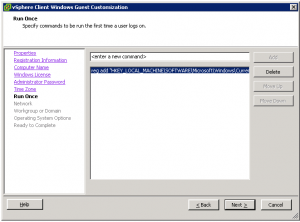
To disable Automatic Windows Updates, all you need to do is add this entry to the RUNONCE area of your customization specification:

It’s that simple!

Sep 3

Most folks with well established vSphere environments don’t have many physical machines left kicking around–but incase you do Converter Standalone 5.0 was released a couple of days ago with some awesome new features:

Preserving the LVM configuration on the source machine during Linux conversions.

Only LVM2 is supported
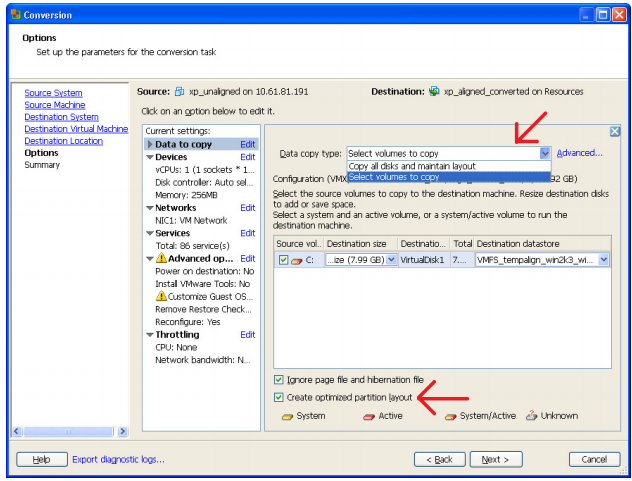
You have to manually do this during the P2V–Under data to copy, hit the dropdown at the top and select volumes to copy.  Then click the Advanced button and select the destination layout tab.  Pick a disk and click To LVG (Logical-Volume Group)

Enhanced synchronization including options for scheduling synchronization tasks and performing multiple synchronization tasks in a conversion job.

You can schedule the synchronization for a date/time you specify now instead of only being able to synchronize immediately after cloning.

You set these options under the Options page–click the Advanced options button.

Optimized disk and partition alignment and cluster size change.

When you are doing a P2V check the box shown below to enable the new alignment feature.  If you are tweak happy you can hit the Advanced button, then select the destination layout tab. You will notice you can change the NTFS cluster size as well.
Conversion data is encrypted between the source and the server.

This should make the security folk happy.

Restoring VCB images.

Take note when using this feature the MAC address will be regenerated, important to note if the machine the VCB image is from was running a licensing server.  Some vendors generate license files based on MAC address, since the MAC address will have changed the license server won’t distribute licenses to clients anymore.  (Products leveraging FlexLM/FlexNet Publisher)  Specific Products that come to mind are: AutoCAD & Rosetta Stone.

Read the full release notes here:  http://www.vmware.com/support/converter/doc/conv_sa_50_rel_notes.html#whatsnew

« Previous Entries Next Entries »